The Letter Before the Novel: Stories in Pieces
Epistolary storytelling uses letters and records to reveal a boarding-house mystery in sequence, helping you shape clues, voices and reader understanding.
How can a story move forward when its characters are separated by distance, silence or time? Epistolary storytelling lets a letter arrive late, a diary page go missing or a notice reach the wrong person. Each fragment gives the reader a particular view, shaped by its writer, purpose and moment of arrival.
The form is often associated with novels made entirely of letters, but it can also combine correspondence with diaries, official notices, receipts and other records. The fragments need not cover every event. Their gaps invite readers to infer what happened between documents while noticing that each account has limits.
Begin with the story that only fragments can tell
Before choosing a format, ask why this story should reach the reader in pieces. Perhaps someone is trying to explain themselves to a person who is absent. Perhaps the central event is over, and surviving documents offer competing accounts. Or perhaps the reader should uncover the past as a character discovers evidence of it.
That reason helps distinguish a useful fragment from a decorative one. A postcard might establish that two people are in different places, but it becomes narratively useful when its wording, omission or delivery changes how the next document is understood. If a conventional scene could do the work more directly, the fragment may not earn its place.
Choose document types that belong naturally to the characters’ lives. A nurse might keep a private notebook and receive family letters; a council clerk might handle forms as well as personal messages. Each kind of writing invites a different degree of candour. A diary can admit thoughts a formal report would conceal, while a polished letter may reveal how its writer wants to be remembered.
Give every fragment a writer, recipient and occasion
A document feels like part of a story when we can sense why someone made it. Who wrote it, who was meant to read it, and what did the writer hope would happen next? The answers can remain implicit, but they should guide the language and selection of detail.
A letter to an old friend may rely on shared references and leave family history unexplained. A complaint to an employer may sound restrained even when its writer is furious. A note never sent can be more candid, but its existence still needs a plausible reason: perhaps the writer lost courage, changed their mind or had no safe way to deliver it.
Keep the practical circumstances in view. Could this person write at the moment shown? Would the intended recipient have access to the document? Does the form fit the setting and the character’s habits? Where a document depends on a particular label, manufacturer’s instructions or local rules, check that detail and adapt the story accordingly.
Plan a week of fragments before drafting the full sequence
A short planning week can reveal whether the documents create movement or merely repeat background. Use a notebook, index cards or a simple table. For each fragment, note its position in the reading order, who wrote it, who receives or finds it, and what changes for the reader afterwards. That change might be a new fact, a contradiction, a shift in sympathy or a question that becomes harder to ignore.
- Monday: Write the central question in plain language. If it is broad, such as “What happened at the house?”, narrow it to the mystery the documents can gradually answer; if the answer is already obvious, choose a question that leaves room for discovery.
- Tuesday: List the people who could leave a written trace and their relationships to the events. If a writer has no plausible reason to make or keep a document, remove that person from the document plan or give them a believable purpose.
- Wednesday: Choose forms that fit those people, such as a booking card, a private letter or a caretaker’s log. If a form feels included only for novelty, replace it with one the character would naturally produce.
- Thursday: Put the fragments in reader order and write beside each one what new understanding it creates. If two entries make the same change, combine them or revise one so it contradicts, complicates or recontextualises the other.
- Friday: Mark what is absent and why. If a gap has a character-based reason, keep it; if no one could plausibly know why the information is missing, add a cue or choose a different point of view.
- Saturday: Draft one early and one later fragment. If the later writer knows or admits exactly what the earlier writer did, adjust their circumstances or give one a distinct motive; otherwise, keep the contrast.
- Sunday: Read the sequence without connective scenes. If you cannot follow who is where and what has changed, add a dated heading or another small anchor; if the basic chain is clear, preserve the gaps that invite inference.
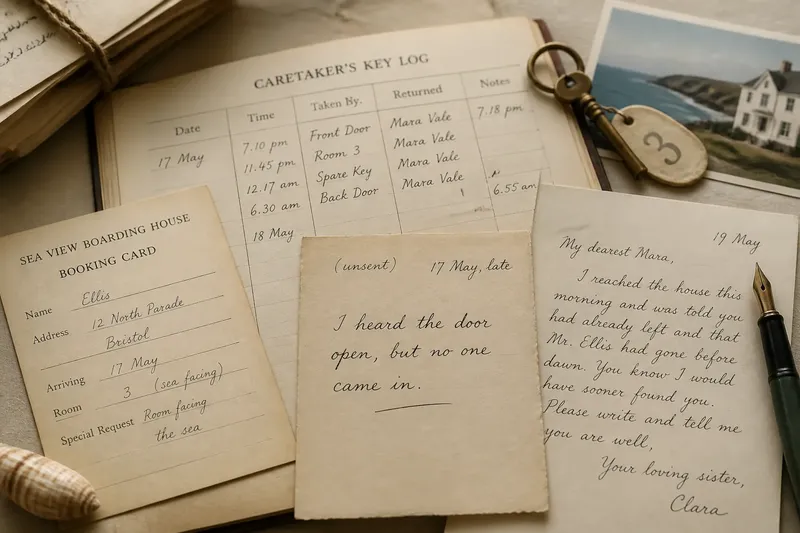
Imagine you are shaping a story about a closed seaside boarding house, and these invented details are your starting materials: a booking card for Mara Vale, a caretaker’s key log, an unsent note from a guest called Ellis and a later letter from Mara’s sister. On Monday, you write the central question: “Why did Ellis leave before dawn?” On Tuesday, you decide that Mara manages the house, Ellis was staying there, and the sister is trying to find Mara. On Wednesday, you keep the four documents because each has a credible writer and purpose.
On Thursday, you order them for the reader: booking card, key log, unsent note, then the sister’s letter. The card says Ellis requested a room facing the sea. The key log records Mara taking the spare key after midnight. Ellis’s unsent note says, “I heard the door open, but no one came in.” The sister’s letter says Mara told her Ellis had already gone when she arrived at the house that morning. On Friday, you leave the reason for the midnight key entry undocumented, because Mara’s account is the very thing the reader should question. On Saturday, you draft the card and note, giving the clerk’s practical language and Ellis’s wary, personal voice. On Sunday, you check that the sequence is legible: readers can see that Mara’s account conflicts with the log and note, and can infer that she may have entered Ellis’s room, while still not knowing why. The documents have changed the question from “Why did Ellis leave?” to “What happened in that room, and why is Mara withholding it?”
Let the gaps carry meaning without hiding the plot
A document-based story asks readers to make connections, but inference needs something solid to work from. Give them recurring names, places, objects or dates that establish a shared world. Then allow the documents to disagree about what those details mean. One writer may call a departure an escape; another may describe it as an ordinary journey.
Think of the fragments as panes in a window: each offers a view through one section, while the frame keeps the pieces part of the same scene. If every pane shows the same thing, the format feels repetitive. If the panes have no shared frame, the reader may lose the thread. A brief note about where a letter was found, or a dated entry marking a change in circumstances, can provide orientation without explaining away the mystery.
Withhold evidence for a reason rather than to prolong suspense by habit. A character may omit a fact because they feel ashamed, fear being overheard or believe the recipient already knows it. The reader should eventually be able to recognise the pressure behind that omission, even if the character never states it outright.
Make each written voice distinct through attention
Different voices do not need exaggerated accents or a pile of quirks. Their differences can come from what each writer notices, what they consider worth recording and how they address the intended reader. One person may describe the weather because it affects a journey; another may mention the same rain only as an excuse for a delay.
Let the document’s purpose shape its sentences. A list of possessions can be spare and practical. A private journal may circle back to a troublesome thought. A formal letter may use careful courtesies to cover a sharp disagreement. Read each fragment aloud and ask whether its writer could plausibly have made it for that audience, at that point in the story.
When does a letter or fragment belong in the novel?
Can a novel mix letters with other documents?
Yes. Diaries, notices, transcripts and personal notes can sit beside letters if they belong to the same story world. Give each form a reason to exist and make clear enough who created it and how it reached the reader.
How can fragments create suspense?
Let one document change the meaning of an earlier one, or reveal that its writer lacks information the reader already has. Suspense grows from the difference between accounts, not simply from withholding every useful detail.
How much should a letter explain?
Give it the information its writer would naturally share with its intended recipient. Leave background unstated when the characters already know it, but include small cues that help the reader follow what matters.
What if the documents feel repetitive?
Compare the change each fragment brings. If two documents deliver the same information in the same emotional register, combine them or give one a different purpose, such as contradicting an earlier account.
Revise the sequence for trust and clarity
Once the fragments are drafted, read them in the order the reader encounters them, not the order in which events happened. Keep a separate timeline for yourself, then check whether readers receive enough orientation to follow changes in place, relationships and knowledge. A concise heading or opening line may do the job; a long explanation often weakens the document’s natural voice.
Next, mark every claim about the same event. Does the difference between accounts feel like an intentional gap in knowledge, a deliberate lie or an accidental continuity problem? You do not need to resolve every disagreement, but you should know what kind of uncertainty the story asks readers to accept.
Finally, remove fragments that only repeat what the reader already understands. Keep one when it changes the emotional weight of a fact, gives a new writer a meaningful presence or makes a later document newly legible. Epistolary storytelling works best when each piece feels like something a character needed to write, while also giving the reader a reason to turn to the next.
Before settling the sequence, return to two questions: what can the reader now infer, and whose version still deserves doubt? If those answers are clear, the fragments can leave room for uncertainty without leaving the reader lost.