A Five-Sense Walk for Building a Setting
A five-sense walk for building a setting helps you gather precise details and choose the few that make a fictional place feel lived in.
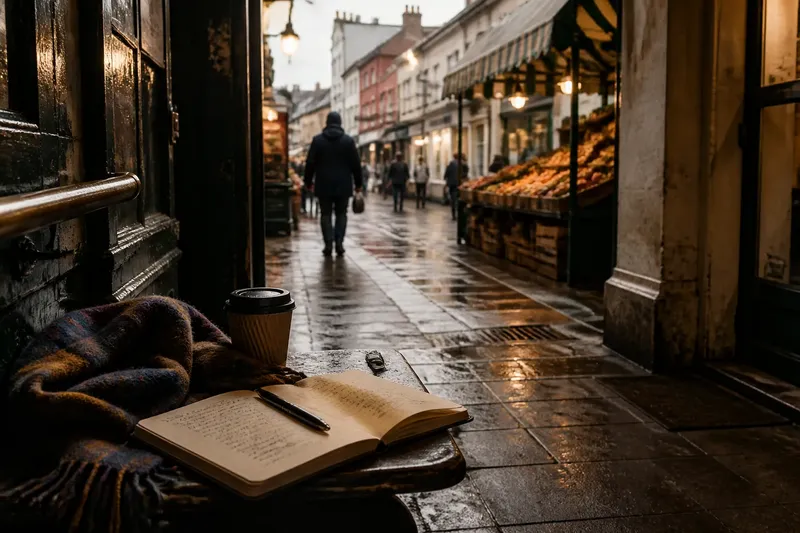
How do you make a fictional place feel specific without stopping the story for a tour? A five-sense walk for building a setting gives you raw material: the sound of a loose sign tapping, the smell of wet wool by a doorway, the grit beneath a shoe. The useful part is not collecting everything. It is choosing details that belong together and give the place a particular character.
Take a short walk through a place you can observe safely and comfortably. It might be a market street, a station, a garden path or the corridor of a public building. You are not looking for a ready-made setting to copy. You are training your attention, then deciding what a fictional place needs.
Choose the walk that matches the setting you are writing
The right route depends on what your draft lacks. If you can picture the layout but the place feels generic, walk somewhere with a strong sensory identity. A covered arcade, a windy bridge or a small grocer’s may each offer different textures, rhythms and kinds of interruption.
If the setting is unfamiliar, choose a nearby place with one comparable feature rather than pretending to know a distant location from a quick visit. A local ferry pier can help you observe waiting, wind and movement; it cannot tell you everything about another community’s customs or history. Treat the walk as a source of sensory prompts, not a substitute for learning what you need to represent responsibly.
If your scene is indoors, look for an accessible public interior with a similar feeling: close or echoing, busy or hushed, orderly or worn. If the scene is outdoors, pay attention to how weather and surfaces shape movement. For a remembered place, walk somewhere that shares one quality with it, then separate what you observe now from what memory supplies.
Pick a route where you can pause without blocking others. Bring a pocket notebook or use a voice memo when it is convenient, but do not record people’s private conversations or make strangers into characters. A few words are enough. You can expand them later, away from the route.
Give each sense a different job
Move through the same stretch of the walk more than once if it is practical. On one pass, attend to sound; on another, notice surfaces and temperature. You need not close your eyes or touch anything. The aim is deliberate attention, not a performance of immersion.
- Sight: Note what catches the eye first, what is partly hidden, and what changes as you move. Record a specific colour, shape or arrangement rather than “old buildings”.
- Sound: Listen for a foreground sound and a quieter one beneath it. A trolley’s rattle may sit over a steady ventilation hum.
- Smell: Notice whether a scent is sharp, stale, warm or fleeting, and where it seems strongest. Avoid treating a passing smell as a permanent feature of a whole neighbourhood.
- Touch: Observe the temperature of the air, the feel of a handrail if it is appropriate to touch, or the resistance of the ground underfoot. Do not handle objects that are not yours.
- Taste: Only note taste if it arises safely and naturally, such as a flavour from something you have chosen to eat. There is no need to sample plants, water or unknown substances; a dry mouth or lingering flavour from your own drink can also be an observation.
Write fragments, not polished prose: “rain ticking on plastic awning”, “warm bread smell at corner”, “door drags on mat”. Fragments preserve the physical cue without deciding too early what it means. Later, you can ask what the cue might suggest about the fictional place and the person moving through it.
Sort your notes by what the scene needs
After the walk, group observations by their possible use. One group might establish location, another might affect movement, and a third might create an emotional undertone. This keeps your notes from becoming a catalogue. A setting detail earns space when it helps a reader orient, feel a change or understand why this place matters to the moment.
Imagine you are writing a scene in a fictional laundrette where someone waits for an apology. Your notes include a detergent smell, a machine’s uneven thump, a plastic chair that shifts on the floor, and a bright poster by the door. The thump could interrupt the silence at an awkward moment; the chair could keep the waiting character from settling. The poster may be irrelevant unless the character notices it for a reason. The expected effect is not that every detail carries symbolism, but that the scene has a few physical points the reader can hold on to.
Think of sensory details like objects in a pocket: a few distinct ones are easy to recognise, while a handful of unrelated scraps becomes clutter. Choose details that share a logic. They might come from the same source, such as a kitchen’s heat and cooking smells, or create a contrast, such as a quiet courtyard beside a loud road.
Keep a note of what you did not observe, too. If you only saw a place in daylight, do not assume how it sounds at night. If you did not enter a building, avoid inventing its smell or texture as if you had. You can choose a plausible detail for fiction, but distinguish invention from observation in your notes so you know what needs further thought.
Use the walk differently depending on the draft
If the setting is hard to picture, prioritise orientation. Notice entrances, thresholds, paths, obstacles and what can be seen from one point. In the scene, give the reader a clear anchor before adding finer texture: a counter, a gate, a window facing the street. A handful of spatial details can do more than a paragraph of atmosphere.
If the scene feels emotionally flat, notice sensory changes rather than adding decorative description. What becomes louder when a character is alone? Which smell disappears when a door closes? A shift in the environment can echo a character’s attention without explaining their feelings for them.
If the setting already feels vivid but slows the scene, return to the draft with a pruning question: does this detail change what the reader sees, hears or expects? Remove repetitions that offer the same impression. Keep one precise sound, surface or smell in place of several broad adjectives.
If you are writing a place unlike any you know, use the walk to learn how sensory details interact, then seek appropriate sources for cultural, historical or community-specific knowledge. Observation can teach you that a queue bends around a pillar or that a draught follows a doorway. It cannot establish how everyone in a real place behaves.
Which details should you keep?
How many senses should appear in one scene?
Use only the senses that suit the moment. A tense exchange may need a scraping chair and a dry mouth, while a quiet exterior scene may rely on light and wind. The exercise uses all five to widen your attention; the finished scene does not need to display them all.
Should every detail come from a real walk?
No. The walk supplies material, but fiction can combine observations or invent what fits the imagined place. Keep the distinction clear in your notes, especially when a detail depends on local knowledge rather than direct sensory observation.
What if a place has no memorable smells or sounds?
Look for subtler contrasts: a room that absorbs sound, a corridor with one bright patch of light, or a cool patch of air near a door. If nothing stands out, that restraint may itself suit the scene; do not force an unusual detail just to make the setting seem vivid.
How can I avoid overloading the prose?
Choose a small set of details with different jobs, then attach them to action or attention. Let a character pass the damp umbrella stand or pause at the ticking radiator instead of pausing the scene for a sensory inventory.
Turn the notes into a setting with a point of view
Before revising, decide whose senses shape the scene. A child may notice the height of a counter; a person in a hurry may register the narrow gap between chairs; someone returning after years away may recognise a smell before the room comes into focus. These differences make sensory selection part of voice, not simply scenery.
Then read the scene and mark each physical detail for its job: orientation, movement, mood or character attention. If two details do the same work, keep the sharper one. If a detail does none of it, remove it or give it a reason to matter. The five-sense walk for building a setting is most useful when it sends you back to the page with fewer, more deliberate choices.
One last check: read the scene aloud and listen for places where description interrupts the action. A setting should not need to announce itself in every sentence. Let one or two carefully chosen sensations linger, and allow the reader’s imagination to supply the rest.