Dialogue or Silence: What a Scene Needs
Dialogue or silence can sharpen a scene’s tension. Learn to choose the exchange or pause that changes what a character knows, risks or can say.
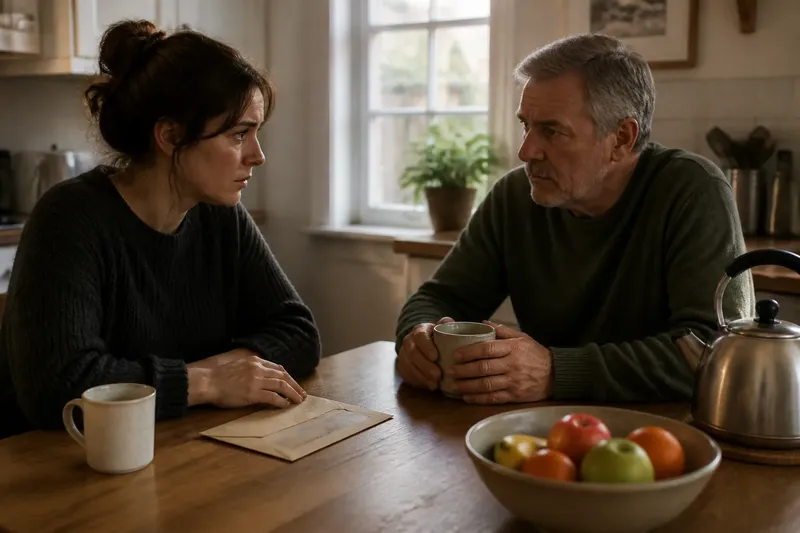
Should this tense scene have dialogue or silence? In a scene about a daughter deciding whether to tell her father she has found his unopened eviction notice, either choice can hold a reader’s attention—but only if it changes what happens between them. The question is not which option feels more dramatic. It is what the moment needs to reveal, conceal or make impossible.
Here is one invented situation, followed closely from its first awkward beat to its result. The details are deliberately small: a kitchen table, a paper notice, a kettle. That scale makes it easier to see how speech and silence do different work, and how a writer can decide which belongs in each part of a scene.
Dialogue or silence should change the moment
Imagine Mara, an adult daughter, sitting at her father’s kitchen table after finding a sealed envelope addressed to him. The envelope contains a notice about his flat. She has opened it, read it and put it back. Her father comes in carrying two mugs and asks if she wants tea.
For now, the situation contains a secret, but it has not yet become a scene. The scene begins to move when the characters meet around that secret. The choice to speak or remain quiet can reveal tension, but each option changes the moment differently.
In dialogue, a character makes something available to the other person. A question invites an answer; a lie gives the other person something to challenge; a half-truth may change the balance of knowledge. Silence withholds that invitation. It can leave another person guessing, force them to fill the gap or preserve a fragile routine. Like a door left ajar, it signals that something is there without showing the whole room.
Neither mode is inherently subtler. A quiet scene can spell out its meaning through an elaborate pause, while a plain line of dialogue can be charged because the speaker has risked saying it. To choose between them, ask what can be different after this beat: what a character knows, what they can deny, what they are willing to risk, or what the relationship now permits.
The first pause lets the secret press on the scene
At the table, Mara’s father sets down the mugs. He asks whether she has been waiting long. Mara looks at the envelope beside the fruit bowl. She says, “Not really.” He reaches for the kettle.
Suppose the scene stops there. The silence around the envelope has a purpose because Mara is making a choice, however temporary: she keeps the notice to herself. Her father can still treat the visit as ordinary. The reader, who knows what she knows, feels the distance between the conversation and the fact it avoids.
That pause would lose force if the envelope were not visible or if Mara had no reason to hold back. Silence needs something pressing against it: a question left unanswered, a gesture that nearly reveals the secret, or a reason the character cannot bear to speak. Otherwise, a pause may be only a pause, not a change in the relationship or the reader’s understanding.
Keep the beat concrete. Mara might fold her hands over the envelope when her father reaches for the fruit bowl. The action adds a small cost to her silence: she has to protect the secret physically. A writer need not explain that she is nervous. The reader can see what her choice makes her do.
The first question tests what speech can do
Now give the father a line: “You’ve been looking through my post?” That question changes the scene at once. It suggests he has noticed something, and it forces Mara to respond to an accusation rather than simply decide whether to confess.
Her answer can change the pressure again. “I thought it was for me” is a lie that may invite scrutiny. “I opened one of your letters” is a confession that gives her father a new fact. “What’s the notice about?” is a question that turns attention towards him. The lines are not interchangeable, even if they all fit the same setting. Each lets Mara take a different risk and hands her father a different kind of power.
That is one useful test for dialogue: if a line could be removed without changing what either character can do next, it may be explanation rather than an active exchange. Useful dialogue can still explain, but it also tends to alter the options. A character’s words might invite trust, close off a subject or make a retreat more difficult.
Say Mara admits that she opened the envelope, then asks, “Were you going to tell me?” Her father replies, “When there was something to tell.” The exchange does not settle the secret; it makes their disagreement plain. The scene has moved from concealment to conflict, and the reader now knows that each character has a different idea of what honesty requires.
A broken exchange reveals what neither can say
After his reply, Mara might begin, “You can’t just—” and stop. The unfinished sentence is not silence added for atmosphere. It shows that she has reached for a rebuke but cannot complete it, perhaps because she knows she has crossed a boundary herself. The break gives the reader a glimpse of restraint and complicity at the same time.
Her father might answer the unfinished thought with “Just what?” If he presses, speech becomes a tool for making her own her accusation. If he turns back to the kettle, his refusal to ask may show that he would rather preserve the routine. The same unfinished phrase creates different tension depending on what the other character does with the opening.
When revising, look at the exchange as a chain of invitations and refusals. A question offered and ignored can be more revealing than a speech about fear. A character who changes the subject has acted; a character who waits for the other person to rescue the conversation has acted, too. Silence becomes legible when it has a target and a consequence.
The physical scene can carry a pause
Speech and silence do not need to occupy separate blocks. A spoken line can be followed by an action that changes how it lands: the father turns the mug so its handle faces Mara, or she slides the envelope away from the fruit bowl. The gesture gives the next pause something specific to hold.
Imagine the father asking, “Do you want me to explain?” Mara does not answer. She pushes the envelope towards him. Now her silence is a response with a visible direction: she is asking him to account for what he has avoided. If she leaves it where it was, the pause might instead preserve the accusation without making him confront it. A small movement can sharpen what a quiet beat means, but the movement must fit the character and the moment.
Setting can also make silence active without turning it into a catalogue of sensations. The kettle clicks off, and neither character moves to pour the tea. That ordinary sound interrupts the conversation at the very point when someone must either continue or retreat. One detail is enough if it changes how the pause feels or what the characters do next.
Be wary of explaining a gesture immediately after showing it. If Mara slides the envelope towards her father, a sentence telling us that she wants him to speak may repeat the action. Add an explanation only if it gives the reader information the gesture cannot carry, such as a conflict she is hiding from him.
Which choice fits this moment?
When should I use silence instead of dialogue?
Use silence when a character’s refusal, hesitation or inability to answer is itself the change in the moment. Anchor the pause in something the reader can observe, such as an unanswered question or a hand withdrawn from the envelope.
How do I know when a scene needs more dialogue?
Add speech when characters need to expose a new fact, make a demand, challenge a claim or alter what the other can reasonably say next. If the line does none of those things, check whether an action or omission would create a sharper change.
Can a quiet scene still feel tense?
Yes, if the reader understands what is being avoided and sees what the characters risk by avoiding it. A small task can carry tension when it gives them a reason to remain together while the important subject stays unspoken.
How can I avoid overexplaining a pause?
Give the pause one clear cue and let the reader interpret it. If a physical action already shows the character’s hesitation, extra narration should add a new conflict or fact rather than name the hesitation again.
The result comes from choosing what can change
Return to the invented kitchen. Mara could confess first, pushing the envelope across the table and saying, “I opened it.” That line changes the father’s knowledge. Or she could wait until he asks whether she has seen his post, then decide whether to answer honestly. That delay changes the cost of her eventual choice. If she says nothing while he pours the tea, the scene may instead show how both of them help the ordinary visit continue.
For a workable draft, mark each beat where the scene shifts. Write beside it what changed: a new fact, a new risk, a boundary tested, or a chance to speak accepted or refused. If a quiet beat has no discernible effect, shorten it, give it an observable action or let the dialogue carry the change. If a line merely repeats what the reader already knows, cut it or give the speaker a reason to say it.
The choice between dialogue or silence is less a contest over which is more powerful than a question of timing. Speech puts one thing into the relationship; silence decides what remains outside it. In Mara’s kitchen, the scene becomes vivid when each pause and line has a consequence—not when every feeling is named, or when every feeling is hidden.
As you revise, listen for the moment that changes what a character can do next. Give that moment a line if speaking makes the risk sharper; leave it quiet if withholding the answer is the action. That is how dialogue or silence can carry tension without asking either one to do work the scene does not need.