The Clue That Explains Too Much
Revise overexplained clues in fiction by separating observable details from character reactions, so scenes stay clear while their meaning unfolds naturally.
How do you keep a clue clear without telling the reader exactly what to think? In fiction, the answer is often to separate what a character observes from what they decide it means. That distinction lets a scene move forward while leaving room for motives and consequences to emerge.
Let a clue change what a character does
A clue earns its place when it affects attention, choice or action. A character might notice that a letter has been steamed open, then hide it before its recipient returns. The behaviour gives the detail weight without pausing the scene for a full explanation.
Try treating clues like objects on a kitchen table: each one takes up space, and adding another does not automatically make the meal clearer. A detail that changes nothing may be decoration. A detail that changes a character’s next move can carry story pressure even before its significance is settled.
Separate observation from the character’s conclusion
An observation is available to the senses: a wet cuff, a torn envelope, a chair pulled away from the table. A conclusion is what someone thinks that evidence means. Keeping the two distinct helps you decide whether a sentence adds information or merely repeats it.
For example, “The window latch was bent” gives the reader an observable fact. “Someone had forced the window” supplies an interpretation. If the viewpoint character is uncertain, the second sentence may be too firm; if they recognise a distinctive tool mark, it may be exactly the information the scene needs.
The choice depends on the character’s knowledge and the scene’s immediate purpose. A reader should be able to picture what happened in the moment, even if the reason for it remains unsettled.
Revise repeated explanations with a decision process
Take a passage where a clue appears and the narration explains it. Work through the passage in order, preserving information that supports the scene and removing sentences that only restate an already visible action.
- Check whether the clue is physically clear. If the reader cannot picture the object or action, add a concrete detail; otherwise, keep the description lean.
- Check whether the character has encountered the relevant name or object before. If not, establish that context earlier or make the character’s recognition uncertain; otherwise, let the existing context do its work.
- Check whether a gesture already conveys the character’s response. If the gesture and an explanatory sentence repeat the same emotion, keep the more revealing one; otherwise, retain both only if they show different reactions.
- Check whether the next action depends on a particular interpretation. If it does, provide the character’s reason or a clear link before the action; otherwise, allow the interpretation to remain open.
- Check whether the clue returns later. If it shapes a later choice, preserve a noticeable detail that readers can recognise; if it has no later role, remove it or stop presenting it as significant.
- Check whether the viewpoint character knows the answer. If they know but are concealing it, show their attention or behaviour rather than an implausibly blank thought; if they do not know, keep their inference proportionate to what they have seen.
Work through a clue without losing the scene
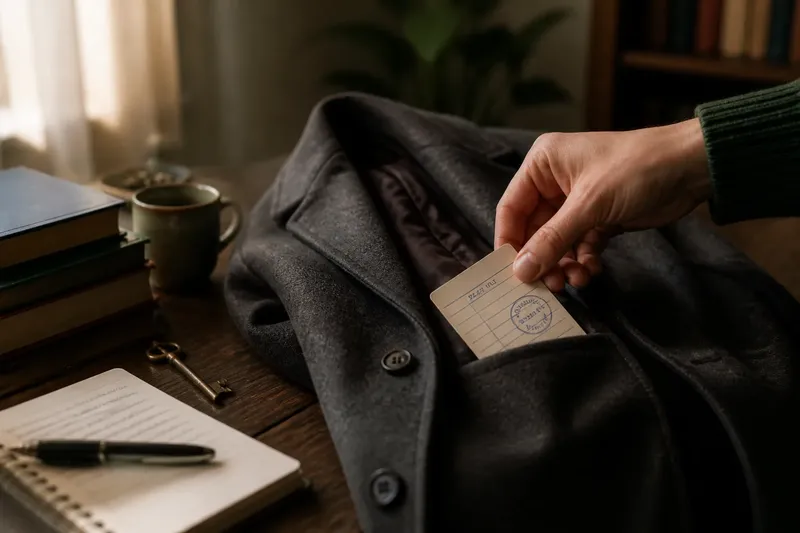
Say you are revising an invented scene in which Mara finds a library card inside her brother’s coat. The scene has already established that he denied visiting the branch, and an earlier page showed Mara noticing that branch’s distinctive date stamp. She turns the card over, sees the familiar stamp and puts it in her pocket. The original draft then adds: “He had lied, so he must have met someone there.”
First, keep the card and the date stamp: those are the inputs that connect this moment to what came before. Next, decide what Mara can know. The denial conflicts with the card, but the card alone does not reveal whom he met. Then compare the actions: pocketing the card shows that she wants to keep the evidence, while the added sentence makes a claim the evidence cannot support. Remove that sentence. The resulting scene tells the reader that Mara has caught a contradiction, while the identity of any visitor remains unknown. The trade-off is deliberate: the immediate lie is legible, but its larger purpose must wait for another scene.
Keep scene logistics clear and motives unsettled
Uncertainty works best around meaning, motive or consequence, not around basic movement. If the door is locked, the train has left or a character recognises a handwriting sample, state the fact plainly when it affects what happens next. Readers can follow an unresolved question more easily when they know where everyone is and what has changed.
Also consider whether a clue deserves its emphasis. A detail repeated across scenes invites attention; a single object may need a direct connection to the action to avoid feeling arbitrary. If you do not want the object to matter, remove it rather than adding an explanation that makes a promise the story will not keep.
Which clue revisions make the scene easier to follow?
Should I explain a clue as soon as it appears?
Explain it at once if the reader needs its meaning to understand the immediate action. If the scene still works without that answer, let the character react and return to the meaning when it affects a later choice.
How do I tell whether I have repeated the same information?
Place the sentence describing the clue beside the sentence explaining it. If both deliver the same fact or emotion, keep the version that best supports the viewpoint and action; if they add different information, retain both.
What if readers could interpret the clue in several ways?
Ask whether each interpretation fits the details already on the page. If one reading depends on information the reader does not have, add context; if several readings remain plausible, let later events clarify which one matters.
When should I remove a clue instead of explaining it?
Remove it when it creates an expectation but affects no choice, relationship or later event. If it does matter, connect it to a character’s action or give it a recognisable return.
Let later scenes pay off attention through action
A clue can gain force when a familiar detail appears in a changed situation. A character who once ignored an unsigned note might later insist on seeing who delivered one. That altered response gives the reader a reason to revisit the earlier moment without a narrator announcing its significance.
When revising an overexplained clue, keep the concrete facts that make the scene legible and test whether the explanation adds something new. The useful search phrase is how to revise overexplained clues in fiction: begin by identifying what the character can observe, then make each remaining sentence contribute a distinct action, fact or decision. The reader can follow the scene without being handed a verdict on every detail.